There’s a bug out there that bites people on the face while they sleep, and most of the time, they never even feel it happen. It’s called a kissing bug, and beyond the bite itself, it’s known for something more serious: the ability to carry the parasite behind Chagas disease. So if you’ve come across a dark, cone headed bug in your home, or woken up with bite marks near your mouth or eyes that you can’t explain, you’re probably here for good reason. Let’s go through what a kissing bug actually looks like, what happens when it bites, and when it’s actually worth worrying about. At Pest Control Mandeville, we help homeowners across Mandeville, LA figure out exactly what’s getting into their homes, seal up the gaps these bugs use to get inside, and deal with the outdoor conditions that draw them in to begin with.
Not sure what’s biting you or your family? Our team at Pest Control offers professional pest identification and inspection services in Mandeville, LA. Schedule a free inspection to get a definitive answer.
What Does a Kissing Bug Bite Actually Look Like?
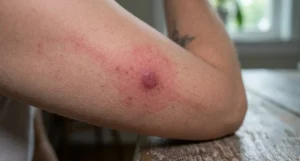
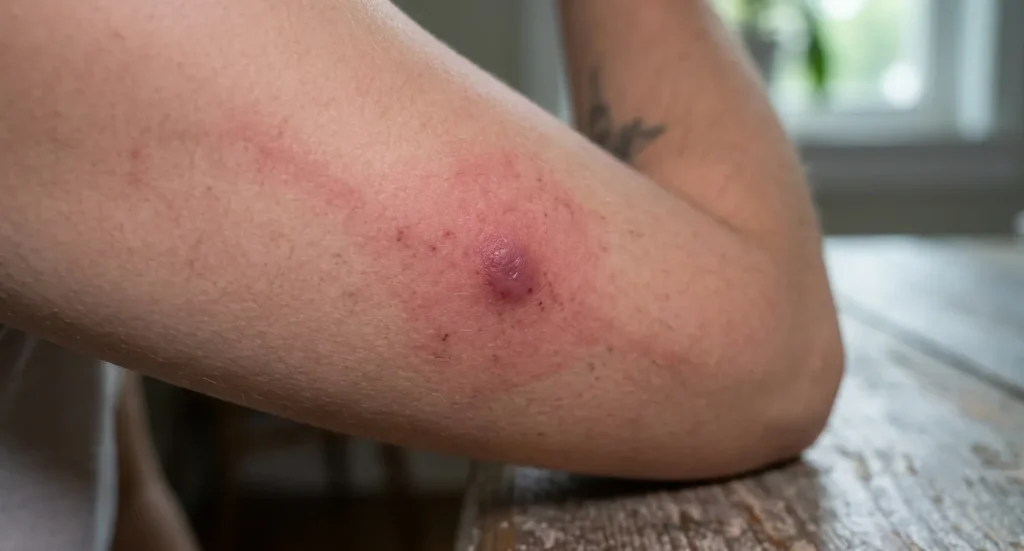
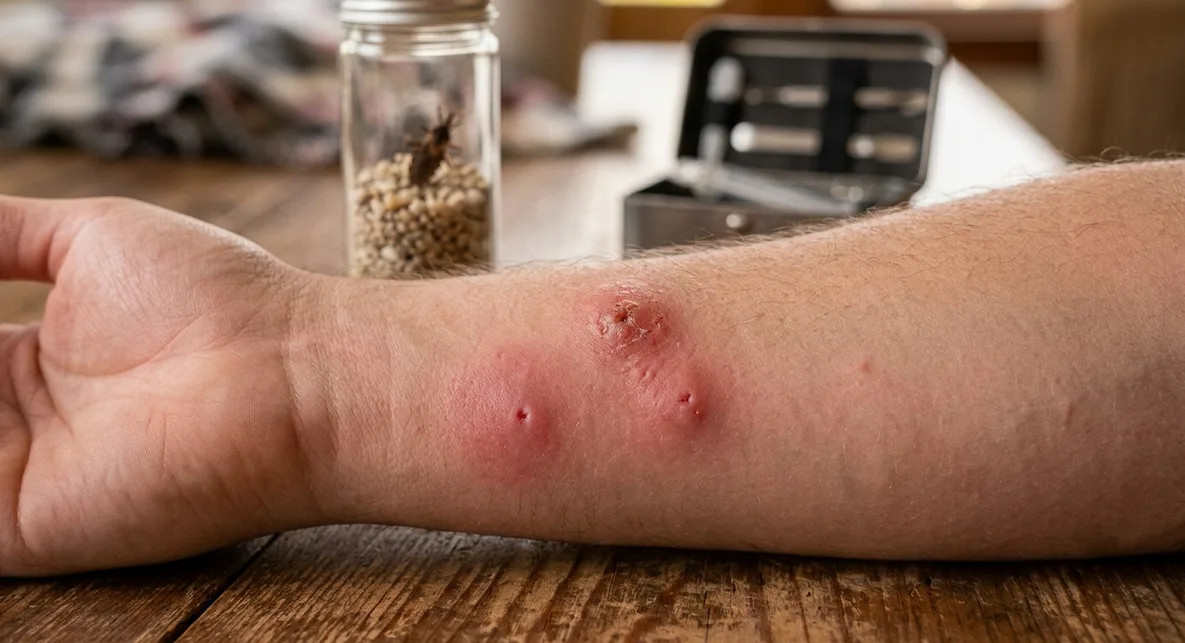
Picture a red, swollen welt, and usually not just one. Kissing bugs tend to feed more than once in roughly the same spot during a single visit, so what you’ll typically see is a small cluster of bites rather than a lone mark. At first it can pass for a mosquito bite, maybe a bit raised, a bit warm to the touch, and sometimes it firms up into a more defined welt by the next day.
Because these bugs are drawn to the breath of someone sleeping, the face tends to take the worst of it, especially the lips, cheeks, and eyelids, where the skin is thinnest. A bite near the eye happens often enough that doctors actually watch for it, since the swelling it causes on just one eyelid is a fairly recognizable pattern.
Can You Even Feel a Kissing Bug Bite?
Here’s the part that surprises most people: you probably won’t feel a thing. The bug’s saliva carries a mild numbing effect, which is how it manages to feed for 20 to 30 minutes while someone sleeps right through it. So if you’re wondering whether a kissing bug bite hurts, the honest answer is usually not, at least not while it’s happening. It’s later, once that numbing effect fades, that the itching or soreness tends to set in.
What Are the Symptoms of a Kissing Bug Bite in Humans?
Everyone reacts a little differently. Some people end up with nothing more than a small red mark that fades within a few days and forget about it entirely. Others notice more, some swelling, itching, redness, maybe a few small hive like bumps clustered around the bite. If someone happens to be more sensitive to the bug’s saliva, the reaction can be a bit stronger, sometimes spreading past the bite site into wider swelling or hives.
That covers the skin reaction, but there’s a separate question worth asking too, which is how you’d actually know if a kissing bug exposed you to something more serious. When early Chagas symptoms do show up, they’re usually mild enough to shrug off, things like a low fever, tiredness, body aches, swollen lymph nodes, and occasionally swelling in just one eyelid. A lot of people who are exposed never notice any of this at all, which is exactly why getting tested matters more than just watching and waiting for symptoms to appear.
How Long Does a Kissing Bug Bite Usually Last?
Most bite marks fade within a few days to about a week, not unlike what you’d expect from a mosquito or ant bite. The swelling and itching are usually the first things to settle down, with any redness fading soon after. If a bite is still hanging around a week later, seems to be growing, or comes with a fever or flu like symptoms, that’s a good sign to check in with a doctor.
How to Treat a Kissing Bug Bite at Home
Good news here, most bites heal fine on their own. Wash the area with soap and water, use a cold compress if it’s swollen or itchy, and an over the counter antihistamine or anti itch cream usually takes care of the rest, basically the same approach you’d take with a mosquito bite.
The one real rule is to leave it alone and resist scratching. Broken skin gives any parasite hanging around in nearby fecal matter an easier way in, so it’s better not to make that easier. And if bites keep popping up, or flu like symptoms show up in the days or weeks that follow, it’s worth having a doctor take a look rather than just waiting it out.
If bites keep showing up around your home, home remedies can only do so much. See our pest control services to find out how we help stop the problem at the source, not just the symptoms.
Are Kissing Bugs Actually Dangerous? Can a Bite Kill You?
The bite on its own isn’t dangerous, it acts like any other insect bite for most people. The actual concern is Chagas disease, and that only enters the picture if infected fecal matter from the bug gets into the bite wound, your eyes, or your mouth, not from the bite itself. Here in the US, real transmission is uncommon, especially compared to parts of Mexico, Central America, and South America, where it’s a much bigger issue.
So can a kissing bug bite actually kill you? Not directly, no. The real danger is Chagas disease going undiagnosed for years, which in a small number of cases can eventually affect the heart. Caught early, treatment works well, which is really the whole reason not to brush off symptoms after a suspected bite.
How Kissing Bugs Are Connected to Chagas Disease
Chagas disease comes from a parasite called Trypanosoma cruzi, and it’s the reason kissing bugs get taken seriously in the first place. Here’s what a lot of people get wrong though, the parasite lives in the bug’s feces, not its saliva, so the bite by itself doesn’t spread it. Infection happens when that fecal matter gets rubbed into the wound, or into the eyes, nose, or mouth, which can happen without anyone even realizing it during sleep.
Early symptoms tend to be mild enough to miss entirely, a low fever, some tiredness, a bit of swelling near the bite. For a smaller group of people, untreated infection can develop into something more serious years or even decades down the line, usually affecting the heart or digestive system. The upside is that antiparasitic treatment works best when it’s caught early, so anyone with a known kissing bug encounter followed by symptoms should get checked out sooner rather than later.
Do Kissing Bugs Fly?
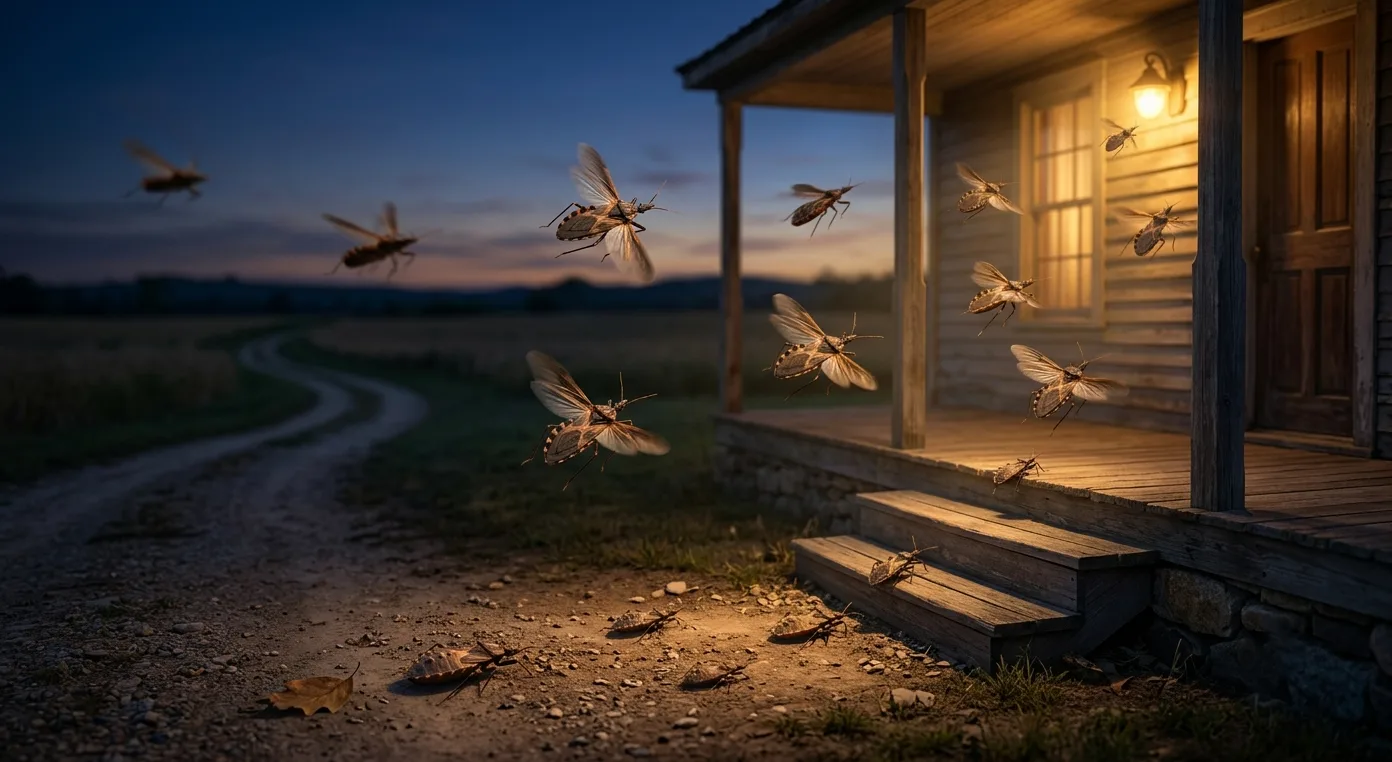
Yes, adult kissing bugs have wings and use them, particularly around dusk on warm nights when porch lights and other outdoor lighting pull them in. Younger kissing bugs, called nymphs, don’t have wings yet and can only crawl around until they mature. They’re not exactly strong fliers though, and tend to stay grounded when it’s windy or raining, though they’ve been tracked flying several miles when conditions cooperate.
Where Are Kissing Bugs Found in the US?
You’ll mostly find them across the southern half of the country, with Texas, Arizona, and New Mexico carrying the largest populations. California has plenty too, especially in rural, foothill, and mountainous areas, where the species Triatoma protracta is the one you’re most likely to run into. They’ve also shown up as far north as Utah, Colorado, Indiana, and Illinois, so this isn’t strictly a bug you only need to worry about in warm climates anymore.
Outdoors, they tend to stick to wood piles, rock crevices, animal burrows, and anywhere near rodent nests. Indoors, they hide in wall cracks, bed frames, and baseboards, basically anywhere close enough to feed on a person or pet.
Kissing bugs are more common in Mandeville, LA than most homeowners realize. Check out our local pest control services to see how we help protect homes in your area.
Are Kissing Bugs Found in the UK?
Nope, they’re not established there. Kissing bugs are native to the Americas, stretching from the southern US down through Mexico and into Central and South America, and the UK’s climate just doesn’t support them sticking around. Any sighting outside their normal range is rare and usually tied to travel rather than an actual local population.
Bugs That Get Mistaken for Kissing Bugs
A surprising number of insects get confused for kissing bugs, which causes a lot of unnecessary worry. Stink bugs, squash bugs, and wheel bugs are the most common culprits. Take the kissing bug versus stink bug comparison, for instance, once you know what to check, it’s actually an easy call. Stink bugs are smaller, shield shaped, and eat plants rather than blood, while a real kissing bug has that longer, cone shaped head built for piercing skin.
A genuine kissing bug is dark brown to black with thin reddish or orange stripes running along its body, while the look alikes tend to be duller or mottled without that clean striping. Wheel bugs even carry a spiked ridge across their back that kissing bugs simply don’t have. If you’re ever unsure what you’re looking at, the safest move is not touching it and having a local extension office confirm it for you.
Why You Shouldn’t Squish a Kissing Bug
It’s tempting, but resist the urge. Squishing one can bring you into direct contact with the same parasite found in its feces. A safer approach is trapping it under a container, sliding a piece of paper underneath to seal it in, then dropping it into rubbing alcohol or the freezer. That way, if you want it identified, you’ve got an intact sample without ever having touched it.
Found a bug you think might be a kissing bug? Don’t take the risk of identifying it alone. Contact us and we’ll help confirm what it is and what to do next.
Frequently Asked Questions
What does a kissing bug bite look like?
Usually a red, swollen welt, often showing up in a small cluster, most commonly around the face, lips, or eyes.
Can you feel a kissing bug bite happening?
Not usually. The bug’s saliva numbs the area, which lets it feed for up to 30 minutes without waking you.
Are kissing bugs dangerous?
The bite itself, not really. The real risk is Chagas disease, and that only happens if the bug’s feces gets into the wound, eyes, or mouth.
Can you die from a kissing bug bite?
Not from the bite directly. The danger comes from untreated Chagas infection over the long term, which can affect the heart in rare cases.
Do kissing bugs fly?
Yes, adults have wings and fly, especially at dusk toward light. Young nymphs can only crawl.
Where are kissing bugs found in the US?
Mostly Texas, Arizona, New Mexico, and California, with sightings as far north as Utah, Colorado, and parts of the Midwest.
Are kissing bugs found in the UK?
No. They’re native to the Americas and don’t have an established population there.
How long does a kissing bug bite last?
A few days to about a week, similar to a mosquito bite.